After spending most of the summer traveling, guiding, and shooting in Central America, I think it is high time I posted some of my newest work. We started off our summer by guiding a group of 14 high school students around Costa Rica for 12 days. It is always great fun to share our love of nature and travel with kids, and get them hooked on exploring the world around them. For the majority of the students it was the first time they had ever left the United States or traveled without their parents.
It is amazing to see how in just 12 days students can go from being timid and shy to approaching strangers on a street corner to buy shaved ice despite not speaking any Spanish. The growth and maturation that happens during these short trips is greater than any classroom experience in the world. It is, as they say, "the classroom of real life".
After sending the kids home with Jen (someone had to fly home with them, and I won the coin toss), I spent a few days with our friends Paulo and Norma at the Sevegre Lodge in the mountains southwest of San Jose. Paulo and Norma picked me up at my hotel in their classic 1980s Toyota Land Cruiser, and as with any good adventure, our first stop was to pick up some "ammo". Of course, all of it didn't make it into the cooler.
Along with sampling some of the world's best imported beers (no Imperial for us), we spent the days hiking and photographing hummingbirds, landscapes, and even a late season Resplendent Quetzal nest. It was also a good chance for me to spend some time getting to know the area before leading a photo workshop there later in the summer.
After leaving Sevegre, we picked Jen up at the airport and then spent a couple of days just chillaxing at Paulo an Norma's house--better known as "Gringo Lodge". I also attended my first Karate class, which, of course, was taught only in Spanish. Despite feeling a little foolish, I actually really enjoyed Karate and would love to take more classes. Next time in English though! A couple of days of relaxing did us good, and we bought some bus tickets and headed for Nicaragua (see previous post).

It was really neat to explore an area that was new to us, and Nicaragua is still less traveled than Costa Rica. We will surely end up spending more time there over the next few years. Because we wanted to travel light and ride local buses, I left most of my camera gear at the "Gringo Lodge". Once we got back into San Jose we took a taxi to Paulo and Norma's office and watched another Karate class, because Paulo was practicing for his Black Belt. Sadly, I sat on the sidelines for this class because Nicaragua had done a number on my digestive tract and I was in no shape to be active.

One of the main reasons we decided to travel to Nicaragua was that I was leading a photo workshop for Foto Verde Tours, but it didn't start until mid-July and thus we had almost three weeks between sending the kids home and starting the workshop. When the time came for me to start the workshop, Jen headed for the airport to pick up our friend Amy, and I headed for the hotel were I would meet my group. Despite the fact that Jen and Amy traveled at one point within a mile of where I was with my photo group, I didn't see either of them again until I was back home near the beginning of August.
For the next 12 days, I worked with my group to photograph
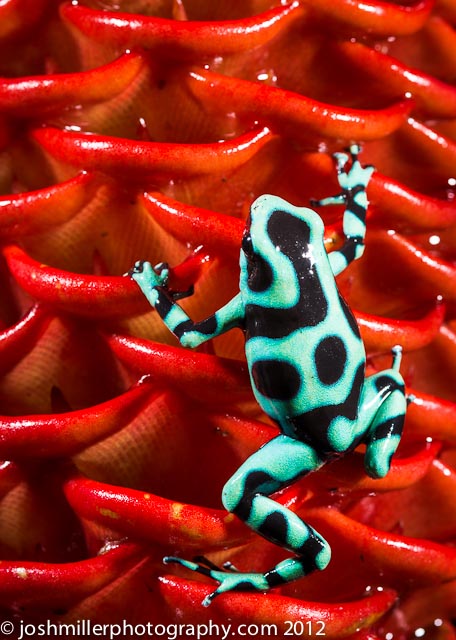
hummingbirds, frogs, landscapes, and even each other. Our trip started
at a lodge in the lower Caribbean lowlands, where we focused mainly on
macro subjects such as frogs and insects.
We then headed back to Sevegre and the oak forest filled with Quetzals and hummingbirds. My favorite shot happened as we were driving the steep dirt road back to the highway on our way to the coast. As we were climbing the hill we looked out the window and noticed a raptor perched in a lichen covered tree. It all happened so fast that we didn't even have time to identify the bird, as it was out of sight before most of the clients had even seen it.

As our driver stopped and prepared to back up, I had the clients get out their longest lenses and quietly slide open the side windows and prepare to shoot. We rolled the bus back down the hill until everyone had a clear view between the trees. I was able to get off just five shots before the immature Red-Tailed Hawk flushed from the tree. It was a lesson in always being ready to shoot, because you never know what you might come across when you least expect it. This is one of my favorite images from the trip, because it illustrates the relationship of the bird to its habitat. I love the character of the oak tree with its hanging lichens and epiphytic plants. The pose of the bird and the amazing soft light don't hurt the photo either.
After our experience with the Red-Tailed Hawk, everyone was looking hard for other roadside wildlife opportunities. With all those eyes, it was hard to miss the Three-Toed Sloth or the Fiery-Billed Aracaris at lunch.


We ended our trip by shooting for a few days around the Jaco area, and having two wonderful sunset photo sessions. The first was planned as part of our long day coming down from the mountains. We scouted for a location that offered easy access and lots of possible compositions for our group. But the second night happened on our way back from spending the day in Manuel Antonio National Park. Everyone was tired and hungry from being in the sun all day. The cameras were packed, and half the group was asleep when we came around a corner and I saw fog forming over the tree canopy. With only moments to spare, we rushed to find a clear vantage point that would allow the last rays of sun to light the fog over the forest. In typical teaching fashion, I first helped my group to get their cameras set up and firing before I focused on my own shots, and I was so rushed that I forgot my cable release in the bus. With only moments to work and without the ability to use mirror lockup, I ended up getting just one sharp image when I borrowed a cable release from another photographer. It was one of those situations when having everything in its place really pays off. Luckily, it was also a situation when one shot was all that was needed.

I always love sharing my passion for photography with others, but I also like to focus on my own work before or after guiding in a location. So before flying home, I spent a few days with my fellow guide, Yehudi, photographing birds and looking for a Glass Frog. Our search for the frog had us standing knee deep and barefoot in a muddy stream during a rainstorm. All told, three of us worked together to use one camera to take 3 total frames. I ran the camera, Yehudi worked with the lighting, and Yehudi's friend held a garbage bag over the camera in an effort to keep it dry. There was no way a single person could have gotten the shot alone, so we all shared the file afterwards--a true team effort.
We also found an Eyelash Viper near Arenal and again worked in a team to create a group of images showing the extremely venomous snake in its environment, rather than just shooting a closeup of it and calling it good.
The last night of my trip ended with a celebration after watching Paulo pass his black belt examination. Finally, the next day, a 4:30am taxi ride and a very long multi-leg flight landed me back in Sacramento almost 24 hours after I woke up that morning.
For those photographers who are interested, this summer I carried a wide range of Nikon gear in my large Gura Gear pack. Warning! This is the gear that I have chosen works best for me to create my work, but it might not be the right thing for you. It is a combination of weight, function, and, of course, value/price.
Nikon D3s
Nikon D800
Nikon 16-35 f/4
Nikon 50 f/1.4
Nikon 70-200 f/2.8
Nikon 200-400 f/4
Nikon 105 macro
Nikon 1.4x & 1.7x extenders
Nikon SB800 X 4 (ended up using a friend's LED light panels more)
TTL Pocket Wizards
Zoom H1 audio recorder and Giant Squid Lav mic
Sennheiser MKE 400 shotgun mic
Manfrotto Nano Light stands
Gitzo Tripods
Various articulating Manfrotto arms and super clamps
Knowing I would be mostly shooting wide angle, macro, or telephoto images, I didn't carry a mid-range zoom to save weight and space. When I traveled to Nicaragua or hiked distances in Costa Rica, I just carried the D800, 16-35, and 70-200.


 After just returning from my very first time shooting during the winter in Yellowstone, I can honestly say it should be a trip on EVERY photographer's list. It is like going on an African Safari in North America! For 6 days we explored the area between the North and Northeast entrance of the park on the only park road open during the winter. Along with Jen, we had the pleasure of hanging out with our great friends and locals Eric Rock and Melissa Scott who often guide wildlife and photography tours in the park.

 I was a bit sad to miss some of these classic spots; but
as a photographer I long ago learned it is better to focus on a small
area rather than spread yourself too thin. Despite not getting close
enough to photograph any Wolves in the Lamar Valley, hearing them howl
while we watched them through binoculars was more than enough payoff for
focusing our time in one area.
I was a bit sad to miss some of these classic spots; but
as a photographer I long ago learned it is better to focus on a small
area rather than spread yourself too thin. Despite not getting close
enough to photograph any Wolves in the Lamar Valley, hearing them howl
while we watched them through binoculars was more than enough payoff for
focusing our time in one area.